

Insights
RERA Insights & Real Estate
Innovations
 28 Oct 2026
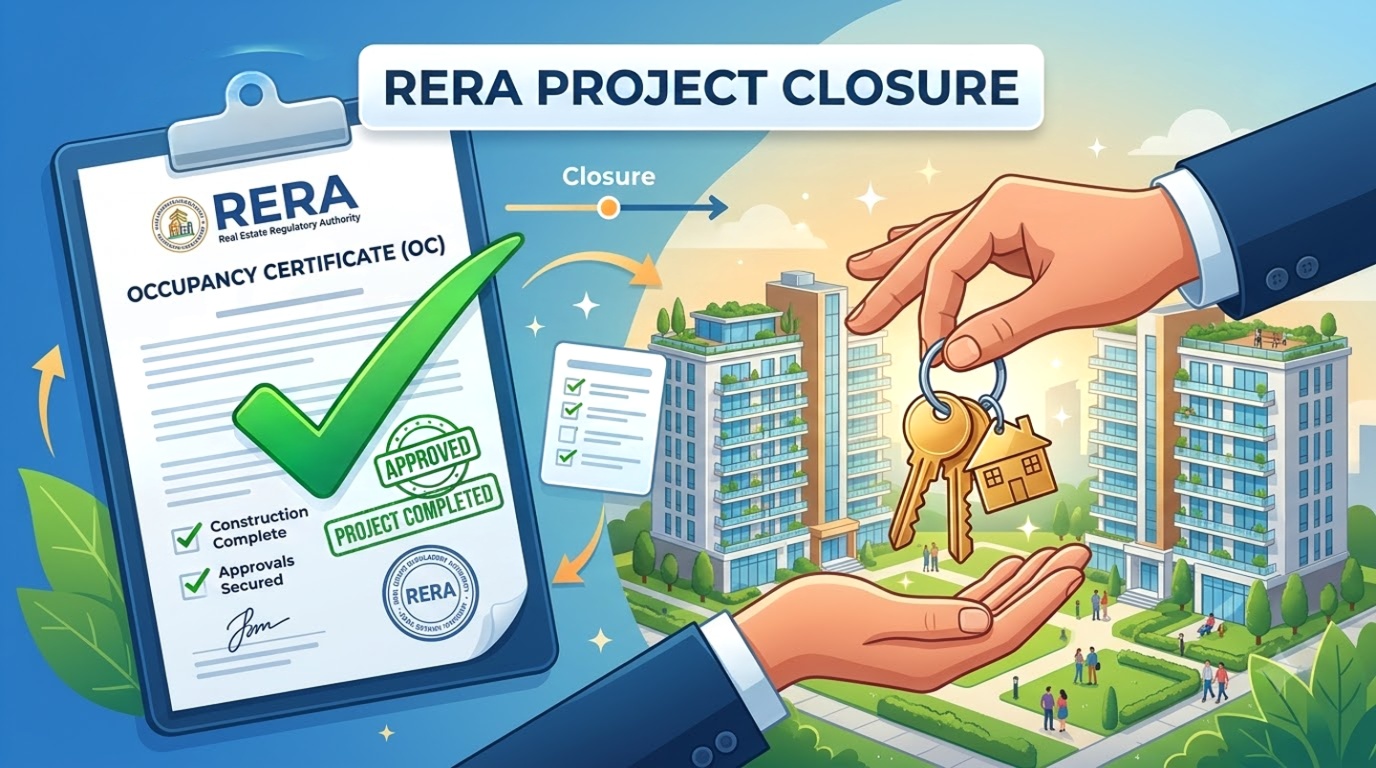
Project Completion and Closure under RERA
Completing a real estate project involves more than finishing construction and handing over apartments. Promoters must also fulfil applicable documentation, certification, disclosure and regulatory requirements under the Real Estate (Regulation and Development) Act, 2016.
For developers registered with MahaRERA, understanding project completion and closure under RERA is essential to avoid compliance issues and ensure that project records are properly updated.
What Does Project Completion Mean Under RERA?
Project completion refers to completing the approved development and fulfilling the applicable legal and regulatory requirements.
Depending on the project, this may involve obtaining the required Occupancy Certificate (OC) or Completion Certificate (CC) from the competent planning authority, submitting the prescribed completion documents and updating the project's MahaRERA records.
The exact requirements depend on the type of project, applicable local regulations and the relevant MahaRERA directions.
What Is Project Closure Under MahaRERA?
Project closure involves completing the applicable regulatory formalities associated with a registered project.
Promoters may need to submit completion-related certificates, update project information and ensure that the required disclosures are available on the MahaRERA portal.
Important: Completing construction, receiving an Occupancy Certificate and completing MahaRERA-related formalities are not necessarily the same step. Promoters should verify that all applicable requirements have been fulfilled.
Key Compliance Requirements for Promoters
1. Obtain the Required Completion Documents
Promoters should obtain the applicable certificate from the competent authority, such as the Occupancy Certificate or Completion Certificate, depending on the project and local rules.
An Occupancy Certificate generally confirms that a building can be occupied in accordance with applicable requirements. A Completion Certificate confirms completion as recognised under the relevant development regulations.
2. Submit Form 4
MahaRERA prescribes Form 4, the Architect's Certificate on Completion of Project, as part of its completion-related compliance framework.
Promoters should ensure that the certificate is prepared by the appropriate professional and submitted in accordance with applicable requirements.
MahaRERA has also issued directions addressing the validation of Form 4 in different completion scenarios, including cases involving an OC or a project whose registration validity has expired. See MahaRERA Order No. 24/2021
3. Update Project Details on the MahaRERA Portal
Promoters are required to keep project information updated under Section 11 of the RERA Act.
Depending on the applicable requirements, updates may include:
Building-wise completion dates
Construction progress and project activity
Booked and sold inventory
Completion-related certificates and documents
Other required project disclosures
MahaRERA's official project update guidance explains the updating process and the importance of maintaining accurate records.
4. Check the Registration Validity
Promoters should check the registered completion date and the validity of their project's registration.
If the project cannot be completed within the permitted period, the promoter should examine the applicable extension procedure and apply as required. Depending on the circumstances, project extension may be considered under Section 6 or Section 7(3) of the RERA Act.
MahaRERA provides separate guidance on project extension applications.
5. Complete Remaining Financial and Disclosure Obligations
Project completion does not automatically eliminate every other obligation.
Promoters should review applicable financial reporting, designated bank-account compliance, outstanding disclosures and other statutory requirements. They should also ensure that their obligations towards allottees and the relevant association or society are fulfilled as required by law.
What Happens If a Project's Completion Date Expires?
If a project's registered completion date expires without the required completion or extension formalities, the promoter may face regulatory scrutiny and restrictions.
MahaRERA publishes information about certain projects kept in abeyance due to the lapse of their completion date. The listed consequences can include freezing project bank accounts and prohibiting agreements for sale or sale deeds until the required compliance is completed.
Promoters can review the official MahaRERA list of projects kept in abeyance due to lapse of completion date.
The action applicable to a particular project depends on its circumstances and the relevant MahaRERA orders.
Project Completion Checklist for Promoters
Before treating a project as complete, promoters should review the following:
Obtain the applicable OC or CC from the competent authority.
Arrange and submit the required Form 4.
Update project information on the MahaRERA portal.
Verify that completion dates and registration records are accurate.
Review outstanding financial and statutory compliance.
Complete applicable conveyance and society-related obligations.
Retain copies of submitted documents and relevant approvals.
This checklist is a practical guide; the exact documents and steps may vary by project.
How RERA Vision Can Help
At RERA Vision, we help developers understand and manage MahaRERA compliance requirements throughout the project lifecycle.
Our support includes project registration, documentation, project updates, extension-related compliance and guidance on regulatory requirements. This helps promoters identify outstanding formalities and maintain accurate project records.
Project completion and closure under RERA require more than finishing construction. Promoters should ensure that the required certificates are obtained, Form 4 and other applicable documents are submitted, project details are updated and all outstanding regulatory obligations are addressed.
By reviewing these requirements in advance, developers can reduce the risk of project delays, regulatory complications and incomplete project records.
FAQs – Project Completion and Closure under RERA
1. What is project completion under RERA?
Project completion under RERA involves completing the registered real estate project and fulfilling applicable requirements, including obtaining relevant certificates, submitting prescribed documents and updating project details.
2. What is project closure under MahaRERA?
Project closure refers to completing the applicable regulatory formalities for a registered project. Promoters should verify the required certificates, disclosures and portal updates applicable to their project.
3. Is an Occupancy Certificate mandatory for project completion?
An Occupancy Certificate (OC) is generally required where applicable under local building regulations. The exact requirements depend on the project, the competent authority and the applicable rules.
4. What is Form 4 under MahaRERA?
Form 4 is the architect's certificate on completion of a project. It is used as part of MahaRERA's completion-related compliance process, subject to applicable directions and requirements.
5. What documents are required for MahaRERA project closure?
Depending on the project, documents may include the applicable Occupancy Certificate or Completion Certificate, Form 4, updated project details and other prescribed compliance records.
6. What happens if a MahaRERA project's completion date expires?
If the registered completion date expires without the required completion or extension formalities, the project may face regulatory scrutiny. MahaRERA may take action under applicable provisions and orders.
7. Can a promoter apply for an extension of the MahaRERA project completion date?
Yes. A promoter may apply for an extension under the applicable provisions of the RERA Act and MahaRERA procedures. Approval depends on the relevant legal requirements and circumstances.
8. Does completing construction automatically close a MahaRERA project?
No. Completing construction does not necessarily complete every regulatory formality. Promoters should verify the required certificates, Form 4 submission, portal updates and other applicable obligations.
9. What is the difference between an Occupancy Certificate and a Completion Certificate?
An Occupancy Certificate generally confirms that a building is fit for occupation under applicable requirements. A Completion Certificate confirms completion as recognised by the competent authority under the relevant regulations. The precise meaning and requirements may vary by jurisdiction.
10. Can MahaRERA freeze a project's bank account due to non-compliance?
MahaRERA may impose restrictions, including freezing project bank accounts, in circumstances covered by its applicable orders. The action depends on the specific project and regulatory directions.
11. Do promoters need to update project details after completion?
Promoters should ensure that project information and completion-related records are updated as required by MahaRERA. The applicable disclosures and timelines should be checked against current directions.
12. What happens to a promoter's responsibilities after project completion?
Completion does not automatically remove every obligation. Promoters may still need to address applicable conveyance, society formation, financial compliance, disclosures and obligations towards allottees.
13. What is the difference between RERA project completion and project extension?
Project completion involves fulfilling the relevant completion and compliance requirements. Project extension is a formal process through which a promoter seeks additional time to complete a project, subject to applicable legal provisions and approval.
14. How can RERA Vision help with MahaRERA project closure?
RERA Vision helps developers understand MahaRERA registration, documentation, project updates, extension procedures and other applicable compliance requirements throughout the project lifecycle.

